
7 Days in Tokyo: A Complete Solo Traveler Itinerary (2026 Guide)
For a city as massive as Tokyo, it is not easy to fit everything into a 7-day itinerary. That is why I also created a dedicated guide covering the best areas in Tokyo, nightlife districts, and social spots in more detail. In this 7 days in Tokyo itinerary for solo travelers, I will give you a compact yet efficient plan to explore the city, meet new people, and make the most out of your trip. From vibrant nightlife and social experiences to aesthetic cafés, hidden gems, and iconic attractions, this guide covers everything you need for the ultimate 7 days in Tokyo.
Although creating your own Tokyo itinerary can be exciting, many travelers end up visiting the same overcrowded tourist spots driven by social media and marketing hype. These places are not always worth prioritizing, especially if you only have 7 days in Tokyo and want to make the most out of your trip as a solo traveler.
This Tokyo travel guide will help you narrow down the best places to visit and things to do during your 7 days in Tokyo. From booking flights and hotels to the best apps for Japan and essential preparation tips, this guide covers everything you need for a smooth and stress-free trip.

Things to Know Before Your 7 Days in Tokyo
Before jumping into this 7 days in Tokyo itinerary, it is important to know these essential travel tips beforehand. Preparing in advance will help you save time, avoid unnecessary hassle, and make the most out of your 7 days in Tokyo.
How Much Does 7 Days in Tokyo Cost?
Before starting your 7 days in Tokyo itinerary, it is important to understand your travel expenses and overall budget. Your budget will shape how you plan your trip, from accommodation and food to nightlife and activities, allowing you to adjust your itinerary based on your spending preferences.
To help you plan your 7 days in Tokyo budget, I can give you an estimated breakdown of the expenses if you follow this itinerary closely. However, this estimate does not include flights or accommodation, since airfare and hotel prices vary greatly depending on your departure country and travel season.
The estimated budget needed to follow this Tokyo itinerary is around ¥11,000–12,600 per day (approximately $70–80 USD), excluding flights and accommodation. This budget should be enough for entertainment, drinks, transportation, and three affordable meals a day, mostly from Japanese chain restaurants or convenience stores. If you are able to spend more, you will have extra room in your budget for experiences Japan is famous for, such as shopping, premium sushi, or authentic Kobe beef.
Where to Stay in Tokyo for First-Time Solo Travelers
When it comes to choosing where to stay in Tokyo, many travelers book multiple accommodations based on the destinations in their itinerary. In most cases, that is a mistake. Tokyo has one of the best transportation systems in the world, making it incredibly easy to get around the city without constantly moving hotels.
If you are solo traveling in Tokyo and want to enjoy the city while meeting new people, Shinjuku is easily the best area to stay. Even if your itinerary does not mainly revolve around Shinjuku, you can simply take the metro to other parts of Tokyo and return to Shinjuku as your base. The main reason is that it is one of the most complete areas in the city. Shinjuku is packed with restaurants, shopping centers, bars, and clubs. Whether you want to splurge on a fancy meal, grab an affordable bowl of ramen, meet people at bars before the night begins, or head straight to the dance floor, Shinjuku has everything you need.
With that being said, Shinjuku is not the only great place to stay in Tokyo by any means. However, if you had to choose just one area to stay in for the next 7 days, Shinjuku is one of the most practical options, especially for first-time solo travelers. If you want to dive deeper and choose the best area based on your travel style, I highly recommend checking out my detailed Tokyo area guide where I break down the different neighborhoods in the city. Unless you already understand Tokyo’s different areas well and know exactly what you are looking for, sticking with Shinjuku is usually the safest and most convenient option for solo travelers wanting to meet people and make the most out of their trip.
If you would like to follow the exact accommodation I stayed at, or you are simply looking for the best hostel in Tokyo for solo travelers, I highly recommend UNPLAN Shinjuku. After staying in multiple neighborhoods and accommodations across Tokyo, this is still the place I consistently return to. The hostel creates an incredibly social environment, making it one of the best places in Tokyo to meet other travelers. On top of that, the location of the hostel is superb. It is located in the heart of Shinjuku, within walking distance of major nightlife districts such as Golden Gai and Kabukicho.
Normally, if you stay elsewhere, you often need to rely on meeting people at bars or clubs before building a group for the night. At UNPLAN Shinjuku, the social atmosphere usually starts almost immediately after check-in. The accommodation is technically a hostel, but the beds are designed more like capsule-style pods, offering more privacy and comfort. There is also a bar downstairs called Encounter by UNPLAN, where guests often gather after checking in. A free welcome drink is usually included, making it incredibly easy to meet other travelers staying there on the same day.
Tip: If you see someone holding a free drink ticket, it is most likely their first day as well. Use it as an easy way to break the ice and make new friends.
Getting Around Tokyo
Despite having one of the most developed transportation systems and infrastructures in the world, there are still challenges when it comes to getting around Tokyo, especially if you go unprepared. The first is how complicated the metro lines can be, and the second is how expensive taxis in Tokyo can get. Fortunately, this guide will give you useful tips to prevent you from getting lost in massive train stations, where it can take quite a while just to find the correct exit or transfer. Although taking taxis is generally not recommended, this guide will also give you helpful tips on how to get cheaper taxis when needed.
Tokyo has the largest urban rail network in the world, which can feel incredibly overwhelming for first-time visitors. With countless train lines and stations operated by different companies, taking the wrong train can easily waste valuable time during your 7 days in Tokyo. This guide will help you understand Tokyo’s transportation system and avoid common mistakes when navigating the city.
First off, you will need a Suica card, which is very important for getting around Tokyo. You can either get one at the airport or add it to your Apple Wallet if you are an iPhone user. It is basically a rechargeable IC card used to get around the city or buy drinks from vending machines, which are everywhere in Japan. If you land at Narita Airport, the metro lines are connected to Terminal 1. So if you arrive at Terminal 2 or Terminal 3, you can simply take the free shuttle bus to Terminal 1 and get your Suica card before heading straight into the city. The main train lines connecting Narita Airport to Tokyo are the Keisei Skyliner and the Narita Express.
One of the most confusing places for first-time visitors in Tokyo is Shinjuku Station, the busiest train station in the world. If you stay in Shinjuku but constantly get lost inside the station, you can easily waste hours throughout your trip just figuring things out. A practical tip for first-time visitors is to find your way to the Yamanote Line. Once you can get to the Yamanote Line, everything becomes much easier. The line runs in a circle and passes through most of Tokyo’s main areas, including Shinjuku, Shibuya, Harajuku, Ikebukuro, and Tokyo Station. Once you understand the Yamanote Line, you can reach most major neighborhoods easily, except for places like Roppongi and Ginza, where you may need to transfer to another line. Also, make sure to use Google Maps instead of Apple Maps when navigating Tokyo trains and stations.
Apart from that, you should avoid using taxis in Tokyo as much as possible. They are not cheap, and they get even more expensive at night. So if you really have to take one, avoid using taxis between 10 PM and 5 AM. But that is easier said than done since the trains stop operating around midnight to 1 AM. This is one of the biggest reasons why Shinjuku is the best area to stay in Tokyo for solo travelers.
During the daytime, you have access to world-class metro lines where you can go almost anywhere cheaply. If you stay elsewhere just to be closer to places like Tokyo Skytree, temples, or museums, you may learn the lesson the hard way because you will probably still end up going to Shinjuku for nightlife anyway. The problem starts after your night out, when the trains stop running. I made this mistake myself once by staying in Asakusa, and my taxi ride from Shinjuku back to Asakusa cost ¥4,500. That experience is exactly why I recommend staying in Shinjuku.
If you need to use taxis in Tokyo, the two most popular ride-hailing apps are GO and Uber. In most situations, GO is the better option because it is usually more affordable and has better driver availability throughout Tokyo. With that being said, Japan heavily regulates taxis, and the drivers on both apps are licensed taxi drivers rather than random people registering to drive. That is also one of the reasons why taxis in Tokyo can be quite pricey.
Summary: Learn the Yamanote Line early, avoid expensive Tokyo taxis whenever possible, and use GO over Uber if you need a ride late at night.
Best eSIM for Japan
The era of buying expensive SIM cards at the airport is slowly reaching its point of extinction. Compared to modern eSIMs, they are more inconvenient and often more expensive with very little upside. With eSIM, you basically just buy a plan from the comfort of your home, install it on your phone, and activate it upon arrival. It is simple, easy, and convenient.
The question is no longer whether you should choose an eSIM or a physical SIM card. The real debate now is eSIM versus pocket WiFi in Japan. And honestly, eSIM is the better option for most travelers. It is cheaper, more convenient, and you do not need to carry an extra device around with you all day.
Having mobile data in Tokyo is extremely important for navigating train stations, using Google Maps, translating menus, and staying connected during nights out. If you would like to follow exactly how my trip went, I highly recommend using Saily. It is easy to set up, works reliably throughout Tokyo, and is one of the more affordable eSIM options right now. It is also extremely beginner-friendly, making it a great option if you are using an eSIM for the first time and want to avoid technical headaches.
With that being said, there are multiple great options on the market, and you can definitely look into different providers before making your decision. But if you want to avoid unnecessary overthinking, choosing Saily is one of the safest and more affordable options I have personally used. The data is fast, reliable, and easy to set up.
7 Days in Tokyo Itinerary for Solo Travelers
Now that you know all the essential things you should know before visiting Tokyo, it is finally time for the actual itinerary. This elite 7 days in Tokyo for solo traveler guide will be a mix of traditional tourist sightseeing and meeting new people to enjoy your trip even more.
At the end of this guide, you will also find an easy-to-read summary chart for this 7 days in Tokyo itinerary, making it much easier to follow during your trip around Tokyo.

Day 1-3 – Arrive in Tokyo & Explore Your New Home for the Next 7 Days
During your first 3 days in Tokyo, it is ideal to stay around some of the city’s most social spots. In this itinerary, I highly suggest spending most of your time in Shinjuku and Roppongi before exploring different parts of Tokyo. This is one of the easiest ways for solo travelers to meet new people and eventually have friends to explore the city with afterward.
On your first day in Tokyo, after dropping off your luggage, you should spend some time exploring your neighborhood. If you stay in Shinjuku like I recommend in this itinerary, you will quickly realize that the area offers much more than just nightlife. Shinjuku is also filled with cafés, shopping centers, gardens, and daytime attractions. After a long flight, café hopping is one of the best ways to recharge before exploring more of Tokyo.
After café hopping around Shinjuku, you should explore some of the best shopping spots in the area, including Lumine Est Shinjuku and Isetan Shinjuku. Lumine Est is a large shopping mall connected directly to Shinjuku Station and is filled with fashion stores, cafés, and lifestyle shops. Meanwhile, Isetan Shinjuku is one of Tokyo’s most famous department stores, known for luxury fragrances and high-end fashion brands.
Then, you can take a quick escape from the overwhelming city and all the activities by heading to Shinjuku Gyoen National Garden. The peaceful atmosphere feels completely different from the chaos of Shinjuku.
The real highlight of Shinjuku is when the sun goes down. There are so many options for your night out that it can genuinely put you in a state of analysis paralysis. But if you replicate my night out plans, you will most likely end up having a great time without needing to do much research. If you stay at UNPLAN Shinjuku like I do or somewhere with a similar social setting, do not stay in your room even if you skip the café hopping and shopping earlier in the day. Just chill in the common area and wait for the basement bar to open. You will most likely end up having small talk with people there before the night even starts. Breaking the ice early is extremely important. Postponing it only makes it harder to meet people later on. The longer you wait, the more control your anxiety has over your actions. Once you break the ice, forming a group becomes surprisingly easy.
Naturally, you will end up going to the basement bar with the people you talked to earlier in the common area. And even if you do not, you will most likely run into them there anyway. This is where the initial group usually forms. Of course, you are not the only one doing this. Other people are also trying to meet people before heading out. Eventually, you or someone from your group will start talking to another group, and it just keeps going from there. It is basically a snowball effect.
Whether you struggle with the first step or already have your initial group for the night, the next spot is almost inevitably Golden Gai, one of the best places in Tokyo for solo travelers to meet people. This is where you are basically conditioned to meet people. The area is filled with tiny bars hidden in narrow alleys, and the atmosphere naturally pushes people to interact. If you fail the first step earlier, you will most likely meet people here. And if you already have a group, you will probably end up meeting even more people unless you go to one of the bigger spots designed more for private groups.
If you are traveling solo and want to socialize during your Tokyo nightlife experience, smaller bars with English-speaking staff in Golden Gai are usually the best option. I personally recommend: Bar Asyl and Bar Question
From there, I usually just go with the flow. There are plenty of good clubs around the area, or you can simply head back to the hostel and have a drink in the common area instead. People who come back after a night out will often grab food from the convenience store across from the hostel and have their late-night meal in the common area anyway. Surprisingly, this is also another great time to make new friends.
For the next day, you should start off your morning by exploring different food items at the nearby 7-Eleven close to the hostel. It is only a minute walk away. If you do not already know it, convenience store food in Japan is completely different from what you might expect in other countries. The quality is superb, and the variety is honestly insane. This is also the perfect time to explore it because once you spend more time around Tokyo, you will naturally feel more convinced to eat at restaurants instead.
This routine works so well that you should honestly repeat it again the next day. But this time, make sure to also try a few different ramen spots somewhere throughout the day or after your night out. The main reason for repeating this flow is simple: Shinjuku is one of the easiest places in Tokyo to meet people, and having friends to explore the city with afterward makes the rest of your trip significantly more fun.
To fully experience Tokyo within 7 days, repeating this nightlife experience once is highly recommended, especially for solo travelers trying to meet people early in the trip. Afterward, you should explore Roppongi, one of Tokyo’s most international nightlife districts. This is also a great opportunity to step outside your comfort zone and become more comfortable navigating Tokyo train lines outside of the Yamanote Line.
Roppongi offers a great social scene, especially if you visit while there is a pub crawl event happening around the area. If you join a Tokyo pub crawl in Roppongi, making friends becomes almost as easy as it is in Golden Gai. A pub crawl is basically an organized event where everyone who buys a ticket goes around different bars and clubs together throughout the night. It is another environment where you are naturally conditioned to meet people. I have met great people there myself, and the organizers are honestly really fun.
The pub crawl events usually only happen on Fridays and Saturdays. So if you arrive in Tokyo on Sunday, Monday, or Tuesday, there is a good chance the pub crawl will not be available during your first 3 days in the city. But that is completely fine. In that case, you can simply switch the Shibuya nightlife plan later in this itinerary with the Roppongi pub crawl instead. That way, you still get to experience all the major social scenes Tokyo has to offer.
Days 4–5 – Harajuku Fashion, Shibuya Nightlife & Tokyo Youth Culture
If you notice, the first 3 days of this itinerary revolve more around nightlife than daytime exploration. That is completely intentional because that is where most of the social scene in Tokyo happens. Unless you genuinely prefer exploring the city entirely on your own, following this flow is extremely important. And later on in the trip, everything will start making much more sense.
Once you have formed a group or met a few new friends, it is finally time to explore different parts of Tokyo together. One of the fun things about Tokyo is that you constantly run into people who are deeply into niche interests like specific fashion styles, vintage clothing, or thrifting culture. And that is exactly why areas like Harajuku, Shimokitazawa, and Shibuya become so interesting to explore. These neighborhoods are known for their strong fashion culture and are some of the best shopping spots in Tokyo.
Shibuya leans more toward mainstream fashion and polished streetwear aesthetics. The outfits you see there are often familiar styles but executed in a much cleaner and more fashion-forward way. Overall, the area feels more commercial and trend-driven. Meanwhile, Harajuku is where much of Tokyo’s youth fashion culture truly stands out. This is where you see clothing pieces combined in ways that feel far more experimental and unique compared to most places around the world. The area is filled with independent brands, niche fashion styles, and strong subculture influences.
Japan in general is famous for its incredible thrifting scene. And for that reason, Shimokitazawa should be the first place you explore on day 4 of your Tokyo trip. The area has a huge concentration of thrift stores and is generally more affordable for shopping compared to Shibuya and Harajuku. So if your budget is close to what I mentioned earlier in this guide, Shimokitazawa will honestly feel like paradise. You can easily find affordable fashion pieces while exploring the countless thrift stores around the neighborhood.
You should follow this order, especially if your budget is around ¥11,000–12,600 per day (approximately $70–80 USD). The flow is honestly very practical for that budget range. But if you have extra budget for the trip, feel free to switch things up naturally based on the flow of your trip. It is generally not ideal to have a super strict list of things to do and follow it religiously if you enjoy exploring Tokyo with the new friends you meet. Most of the time, it is more fun to visit places they recommend, and you can also suggest places from this itinerary to them. That way, the trip feels much more natural instead of feeling like a checklist.
Simple rule: If you do not have much extra budget, start with Shimokitazawa first. Once you explore the thrifting scene there, you will have a much better idea of the pricing and how much you are realistically spending on shopping. Let’s say you do not buy much while exploring Shimokitazawa. Then you can simply carry over the unused budget to the next day when you explore Shibuya, where you will most likely need the extra budget anyway.
After exploring Shimokitazawa, you should head to Harajuku next. Its unique fashion culture is best experienced before moving into the more commercial atmosphere of Shibuya. Harajuku is where Tokyo’s experimental fashion scene truly stands out, and simply walking around the area already feels like part of the experience. Apart from fashion, Harajuku also has countless trendy cafés to choose from. Many of them have unique themes, and you honestly never get tired of exploring them. Some are just aesthetic cafés, while others are inspired by anime, movies, or video games. You could easily spend most of your day café hopping around Harajuku.
The moment the sun goes down, it is time to head straight to Shibuya. But this time, it is not about shopping yet. This is where you experience a completely different side of Tokyo nightlife — the youthful, fashionable, and energetic atmosphere that Shibuya is known for. If you stick to the more popular nightlife spots around the area, meeting new people also becomes surprisingly easy. You can check out my recommendations for different clubs, but if you only have a couple of nights around Shibuya, the safest option is honestly ATOM Shibuya. The venue is massive and has different floors with different types of music. The main floor usually plays mainstream music, which I personally think creates the best atmosphere. Mainstream music naturally attracts bigger crowds than niche genres, and it is also the type of music everyone can sing along to anyway, which is a huge plus.
If you stay in Shinjuku like I suggested earlier, I would honestly recommend just staying out in Shibuya until almost 5AM instead of paying for an expensive taxi back. Most of the clubs around the area are right next to each other anyway, so it is super easy to walk around and explore different venues throughout the night. But make sure to spare some time for your late-night meal before the trains start operating again. Personally, I would probably leave the clubs around 4:30AM-ish. If you have a good group with you, you can just head straight to Ichiran Ramen since it is within walking distance from the club area anyway.
If you still have not gotten a bigger group from clubbing, head straight to the Lawson next to ATOM Shibuya. This is basically the convenience store where everyone around the club area goes after their night out to grab food before the trains start operating again. Since everybody there is still in a party mood, people naturally break the ice sometimes. Or honestly, you can also just start the conversation yourself. The vibe is usually super friendly anyway. And strangely enough, the post-night-out convenience store experience in Shibuya is sometimes even better than the actual clubbing itself.
Once Tokyo trains begin operating again around 5AM, you can return to your accommodation cheaply without relying on expensive late-night taxis. After resting, head back to Shibuya during the daytime to experience its famous shopping districts, fashion culture, and cafés.
Shibuya is one of Tokyo’s biggest shopping and fashion districts, which can make the area feel overwhelming for first-time visitors. To help narrow things down, here are some shopping spots I highly recommend exploring. One of the best shopping malls in Shibuya is Shibuya PARCO. The mall is known for its stylish atmosphere, local Japanese fashion brands, designer stores, and unique lifestyle shops that are difficult to find outside Japan.
Shibuya 109, Center Gai, and Shibuya Cross are honestly nonnegotiable. These are the iconic spots in Shibuya. Missing them is almost like going to Paris without seeing the Eiffel Tower. After finishing your personal shopping, you should definitely head to Don Quijote Shibuya. It is one of the biggest Don Quijote branches, and you will find endless souvenir options there.
Every single time I go to Tokyo, I tell myself I will just grab some quick souvenirs from Don Quijote, but that honestly never happens. There is something weirdly mesmerizing about the place that makes you spend hours there. The more you explore, the better the items you find. Although Don Quijote basically has everything, one trick to avoid spending your entire day there is to narrow down the categories of things you actually want to buy before entering. For me, it is collectibles and snacks. The moment I start exploring outside those categories, I know I am cooked.
Days 6–7 – Ginza Luxury & Asakusa’s Cultural Contrast
If you are the type of person who enjoys the finer things in life, then Ginza is absolutely the place for you. The district has one of the biggest concentrations of flagship stores and luxury brands in Japan. While Ginza can definitely get expensive, there are still some brands and stores that feel surprisingly accessible, at least in 2026.
One brand you should absolutely check out is Onitsuka Tiger. Popular models like the Onitsuka Tiger Mexico 66 are still relatively affordable in Japan compared to many other countries. And honestly, Ginza is one of the best places to buy them for many reasons.
The first reason is that Onitsuka Tiger is significantly more affordable in Japan compared to many other countries. The second reason is that if you visit the flagship store in Ginza, you can have your name embroidered onto your pair. This customization experience is exclusive to the Ginza flagship location, which makes the shoes feel even more special as a souvenir from your Tokyo trip.
One important thing to keep in mind is that there are actually three different Onitsuka Tiger stores in Ginza: the flagship store, the Red Concept Store, and the Yellow Concept Store. Each one offers a slightly different atmosphere and shopping experience, and honestly, all three are worth visiting.
However, the first one you should prioritize is definitely the flagship store. It is the only branch that offers the embroidery service for your shoes, and they only customize the first 200 pairs each day. So if you casually wander around Ginza first and decide to visit the flagship later, there is a very high chance you will miss the embroidery opportunity entirely.
At first, 200 pairs might sound like a huge number, but the demand is honestly much higher than most people expect. Many people start lining up before the store even opens just to secure a queue ticket for the embroidery service. The printed queue usually starts being distributed around 10:00AM–10:30AM, while the actual store opens at 11:00AM.
And surprisingly, some people even arrive before the queue distribution begins. That is how popular the embroidery service has become. Once the staff gives you your queue ticket, they will usually ask you to come back at 11:00AM if you are part of the first batch. Only around 15 people are allowed inside the store at a time. If your queue number is outside the first group, you can simply scan the QR code provided by the staff to track the line and check the estimated time for when you should return.
Nightlife in Ginza is honestly not really my thing, but if you enjoy jazz bars or cocktail lounges, you will probably love it there. The nightlife scene feels much more refined and relaxed compared to places like Shibuya or Shinjuku. But if you are a solo traveler trying to meet people, I would honestly just skip Ginza nightlife. Just like typical jazz bars and cocktail lounges anywhere else, people are usually more closed off within their own groups.
Exploring your favorite brands and experiencing Ginza, Tokyo’s most refined district, can definitely be fun. But realistically, it is usually not something that takes up an entire day unless you are doing serious luxury shopping. So after you feel like you have explored enough around Ginza, I highly recommend heading to Asakusa next for a completely different side of Tokyo.
Asakusa represents the more traditional side of Tokyo. The atmosphere shifts almost immediately the moment you step out of the station. Lantern-lit streets, rickshaws, kimono rentals, and old-style storefronts create a completely different feeling compared to the modern energy of other districts in Tokyo.
The contrast becomes even more noticeable if you head straight from Ginza to Asakusa. It almost feels like moving between two different worlds within the same city. That sudden change in atmosphere is honestly part of what makes Asakusa so interesting to explore.
You should definitely spend some time wandering around the area to admire the traditional architecture and cultural atmosphere. Wooden-style facades, shrines, temples, and Edo-inspired design elements are everywhere, creating a side of Tokyo you rarely experience elsewhere in the city.
If you do not have much time left during the day, the first place you should head to in Asakusa is definitely Sensō-ji. It is probably the iconic Japanese temple you have already seen countless times on Instagram and travel videos. Regardless of whether you believe in fate or not, I highly recommend trying an omikuji, also known as a fortune slip. It is honestly part of the full temple experience. The process is simple. You place a ¥100 coin into the box and shake the container until a numbered stick comes out. Each stick corresponds to a numbered drawer nearby, and you simply match the number on the stick to the correct drawer to receive your fortune slip.
Once you get your fortune slip from the drawer, take a moment to read it. If you receive good luck, you should keep the paper. But if the fortune is bad, you can tie the paper onto the metal racks next to the booth instead. Traditionally, this symbolizes leaving the bad luck behind rather than taking it with you. And honestly, if you do not really believe in fortunes anyway, you can also just keep the paper as a souvenir even if you end up getting a bad result.
Right after drawing your fortune slip at Sensō-ji, you should definitely spend some time trying the street food around Asakusa. It is one of the few places in Tokyo where you can still find a proper street food atmosphere. Just keep in mind that many smaller food stalls only accept cash payments, so having some yen with you is important. After that, you can simply enjoy the street food while wandering through the traditional streets and atmosphere of Asakusa.
Right before sunset is one of the best times to visit Tokyo Skytree, one of the most famous observation towers in Tokyo. Located in Oshiage within Sumida City, Tokyo Skytree offers panoramic views of both the daytime skyline and Tokyo at night. Traveling there from Asakusa is very easy since Oshiage Station is only one stop away via the Tobu Skytree Line. Many travelers also choose to walk between the two areas because of the relatively short and enjoyable route.
If you have a bit of extra budget for this experience, I highly recommend getting the Combo Ticket for Tokyo Skytree so you can access both the 350m and 450m observation decks. If not, the standard Tembo Deck at 350m is still absolutely worth it. The Combo Ticket usually costs around ¥3,500–¥3,800 or higher, while the regular Tembo Deck ticket is around ¥2,100–¥2,300 depending on whether you visit on a weekday or weekend. You can also sometimes find slightly cheaper prices by purchasing tickets online in advance.
If you want the best pricing possible for Tokyo Skytree, I would honestly recommend booking your ticket online through Klook instead of buying it on the spot. The benefit is not just cheaper tickets sometimes, but also avoiding the hassle of lining up just to get your ticket.
The main reason I recommend going around sunset is because you get to experience Tokyo from above during both daytime and night time. You really get the best of both worlds. Most people visit only at night, and honestly, that makes complete sense because Tokyo looks incredible after dark. But there is also something special about seeing the city under natural light before it slowly transitions into the night time skyline.
After exploring Ginza and Asakusa, you should head toward Shiba Park in Minato City to see Tokyo Tower up close. The area around the tower is beautiful to walk around briefly, especially at night when the city lights start reflecting across Minato. You can spend a little bit of time exploring Minato City, although honestly, there are not too many major things to do there compared to other districts in Tokyo. After that, head straight toward Roppongi.
And if you still have some extra budget left for the trip, this is honestly one of the few times a taxi ride in Tokyo actually feels justifiable. Taking a taxi from Tokyo Tower to Roppongi at night feels incredibly cinematic. Seeing Tokyo Tower glowing behind the city while driving through Roppongi captures the exact atmosphere Tokyo is often romanticized for in movies, music, and travel videos. It honestly becomes a very memorable final ride.
The reason you head to Roppongi is not just because of the scenic taxi ride. If you still have not properly explored the nightlife scene there after your pub crawl, Roppongi is honestly a great choice for your final night out in Tokyo. The area is home to several internationally recognizable nightlife venues and has a more upscale international atmosphere compared to other nightlife districts in the city.
One venue worth checking out is 1 OAK Tokyo, especially if you have never experienced it in cities like New York City or Dubai before. It is also known as one of the spots where artists, celebrities, and international figures sometimes go when visiting Tokyo. The line can definitely get long and move slowly, but honestly, it is still worth experiencing at least once.
7 Days in Tokyo Itinerary Summary
Reading through all the details is definitely better, especially if your goal is meeting new people and making friends as a solo traveler in Tokyo. But if you are already in Japan or simply do not have much time to go through everything in detail, you can quickly check the summary tables below instead.
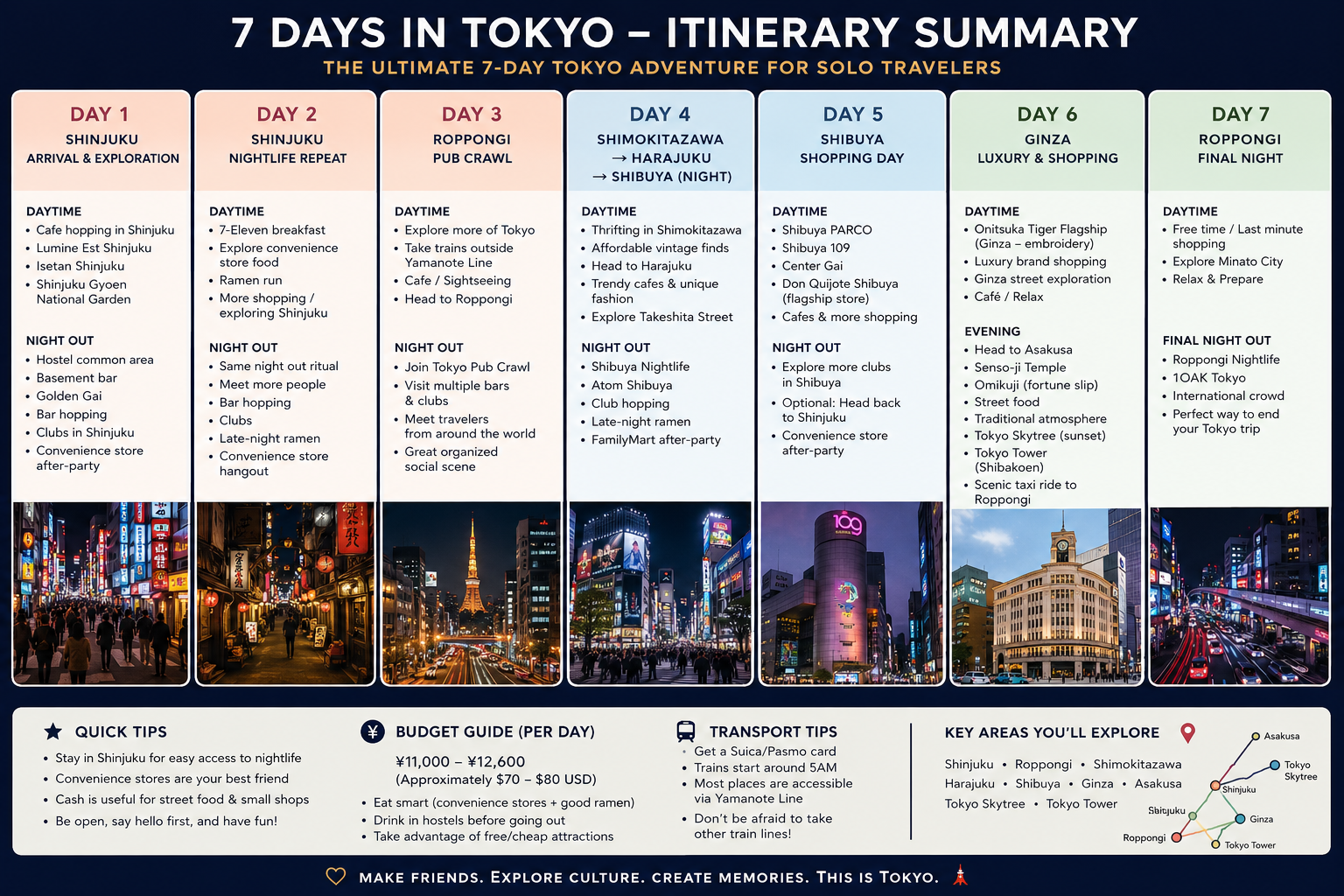
If you only look at the 7 days in Tokyo itinerary summary, you will most likely miss many of the important details about how to actually meet people and make friends as a solo traveler in Tokyo. The summary tables are mainly there to give you a quick overview of the destinations and overall flow rather than the full social experience behind the itinerary.
To truly have a social solo travel experience in Tokyo, the smaller details honestly matter a lot. Compared to the summary tables above, the full guide explains exactly how to approach these nightlife spots, why certain places work so well for solo travelers, and how people naturally socialize in those environments.
Many of these recommendations are also highly context-dependent. For example, the “Lawson after-party” is not just about going to any random convenience store. It specifically works because of the exact location, timing, and nightlife flow around that particular area — details that are difficult to fully explain inside a small summary chart.
To keep things short and simple, stay in Shinjuku, experience nightlife in Golden Gai and Shibuya, thrift in Shimokitazawa, and explore the traditional side of Tokyo in Asakusa.
Tip: Before booking your hotel/hostel, compare the same property on Trip.com first. In Asia especially, the pricing there is sometimes noticeably cheaper for the exact same room. This can honestly save you a significant amount of money on trips longer than just a couple of days.
This 7 days in Tokyo itinerary is designed for solo travelers who want to maximize their limited time in Tokyo while also meeting people and experiencing the city socially. However, travelers staying longer in Tokyo may benefit more from understanding the different neighborhoods and choosing accommodations based on their preferred atmosphere, nightlife, shopping, or cultural experiences.
If you know Tokyo well enough and understand how the social scene works, meeting people is definitely not limited to Shinjuku alone. There are many areas in Tokyo where social experiences can naturally happen.
However, for first-time solo travelers who want the highest chance of meeting people, making friends, and creating good memories during a short trip, I honestly recommend following this itinerary fairly closely. Of course, you can still squeeze in other places you personally want to visit along the way.
If you have been to Tokyo and visited some of the places I mentioned, I would honestly love to hear about your experience — especially if you ended up meeting people there. Feel free to share your stories in the comments below.
You can also check out more of my solo travel guides here.

I write practical solo travel guides focused on nightlife, cafés, social experiences, and realistic itineraries around Asia and beyond.
Here, you’ll find experiences that help you travel more confidently, meet new people, and make the most of every trip.
